Lisbon City CouncilContactsEN
Building eras

Every building followed the rules of its time.

Knowing when it was built tells us how it is made inside, what tends to fail in an earthquake and how it is strengthened.
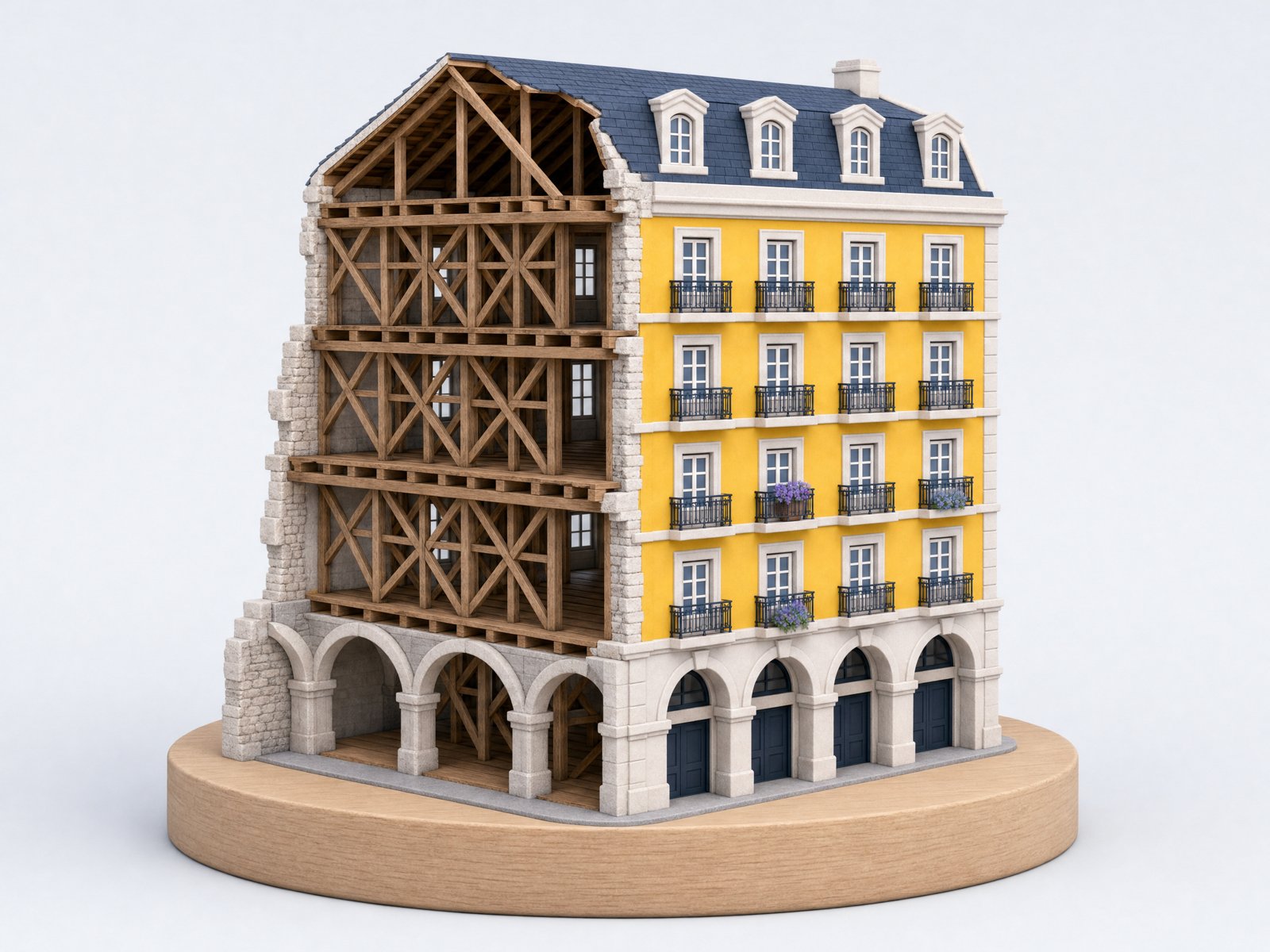
Cut-away model · tap the numbers
In these buildings

Pre-Pombaline and Pombaline

POINT 1

Stone arches and brick vaults on the ground floor

  • 5 storeys, arranged in city blocks.
  • Stone masonry façades, with regular, symmetrical openings.
  • Ground floor with stone arches and brick vaults, on masonry walls and piers.
  • Upper storeys with timber floors, resting on the façades and on timber-framed frontal walls.
Where they are found

Pre-Pombaline buildings in the historic quarters: Alfama, Castelo, Mouraria and Bairro Alto. Pombaline buildings in the Baixa Pombalina and the areas around it.

See on the map
Pre-Pombaline · before 1755

Stone masonry and timber, 2 to 3 storeys, timber floors resting on interior walls. The upper storeys may project over the ground floor (jettied storey).

Most common problems

What tends to weaken these buildings

Demolition of interior walls

In particular the load-bearing frontal walls.

New or widened openings on the ground floor

In the ground-floor façades, especially in commercial premises.

Most common solutions

How they are strengthened

Continuous walls, and never less wall below than above.

  1. 1Aligned wallsBuild or rebuild walls aligned from the ground floor to the roof, without interruption.
  2. 2More wall lower downMake sure every storey, the lower ones in particular, has an area of load-bearing walls greater than or at least equal to that of the storey above.
Structural strengthening is work for an engineer
These are the most common solutions for this era. Every building has to be assessed by a civil engineer before any works. Source: Lisboa Urbanismo summary sheets · archetypes by Diana Roth and Pedro Loureiro.
Guides

Building eras

1Stone arches and brick vaults on the ground floor
Before 1800Pre-Pombaline and Pombaline
Most common problems
!Demolition of interior wallsIn particular the load-bearing frontal walls.
!Widened openings on the ground floorIn the ground-floor façades, especially in commercial premises.
Eras